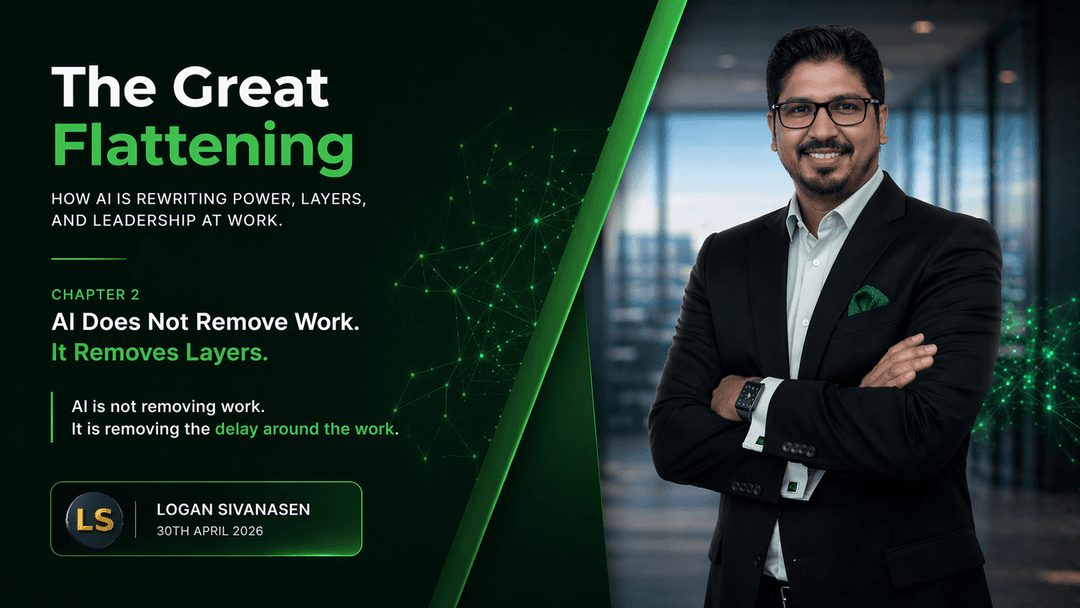
The Great Flattening - Chapter 2: AI Does Not Remove Work. It Removes Layers.
Chapter 2 of The Great Flattening series. AI is not removing work. It is removing the delay around the work. The approvals, the formatting, the status updates, the meeting summaries, the handoffs - these are not the work. They are the layers around the work. And when the layers go, the work accelerates.
Chapter 2 of The Great Flattening.
AI is not removing work.
It is removing the delay around the work.
This is the most important distinction in the current conversation about AI and organizations. And most leadership teams are missing it.
The fear narrative says AI will eliminate jobs. The hype narrative says AI will 10x everyone's productivity instantly. Both miss what is actually happening in the organizations that are implementing AI most effectively.
What those organizations are discovering is that most of their "work" was never really work. It was layers. And the layers are the first thing to go.
What a Layer Is
A layer is anything that sits between a decision and the action it enables. Between an insight and the person who needs it. Between a question and its answer.
Layers come in several forms:
Approval layers: The chain of sign-offs required before something can happen. Not because each approver adds unique value, but because the organization has not established trust-based decision rights.
Translation layers: The work required to move information from one format to another. The analyst who takes raw data and turns it into a slide. The manager who turns a technical recommendation into a business brief. The communicator who turns a decision into a message.
Coordination layers: The scheduling, the meeting prep, the follow-up, the action item tracking. The organizational connective tissue that exists because humans have limited bandwidth and attention.
Verification layers: The reviews, the QA checks, the compliance confirmations that exist because errors have historically been caught late and fixed expensively.
None of these layers are intentionally wasteful. Each one was added because, at some point, it solved a real problem. The approval chain prevented bad decisions. The translation work made information accessible. The coordination ensured things did not fall through cracks. The verification caught errors before they were costly.
The problem is that these layers accumulated over decades. And they now consume a disproportionate share of organizational energy.
Asana's 2026 Anatomy of Work Global Index found that workers spend 58% of their time on work about work: communicating about tasks, searching for information, switching between apps, and attending meetings to coordinate what the actual work should be. Only 33% of time goes to skilled work specific to their role.
The layers have consumed the work.
How AI Removes Layers
AI does not attack the work. It attacks the layers. Specifically, it removes layers that exist because of human bandwidth limitations.
The approval layer thins: When AI can draft, summarize, and contextualize a recommendation before it reaches an approver, the approver's job changes. Instead of reading raw data and forming a judgment from scratch, they review an AI-generated recommendation and apply their judgment to validate, modify, or override it. The approval is still human. The time is dramatically shorter.
The translation layer disappears: The analyst who spent 80% of their time pulling and formatting data and 20% of their time actually analyzing now operates in reverse. AI handles the pulling and formatting. The analyst spends 80% of their time on analysis and interpretation. The insight reaches the decision-maker faster and with more depth.
The coordination layer automates: Meeting scheduling, action item tracking, follow-up drafting, status aggregation - AI handles this continuously and accurately. The human bandwidth that went into coordination is returned to the work itself.
The verification layer accelerates: Instead of manual QA that happens periodically, AI runs continuous verification in the background. Errors are caught earlier, faster, and with more precision.
The layers do not disappear overnight. But they thin. And as they thin, the work that was buried underneath them becomes visible.
What the Work Actually Is
Here is what emerges when the layers go away:
Judgment: The calls that require context, values, experience, and an understanding of what is at stake. AI can provide input. Humans make the call.
Creativity: The combination of ideas in new ways. The insight that comes from lived experience and cultural understanding. The solution that is not in the training data.
Relationship: The trust built over time. The negotiation that requires reading a room. The leadership that requires a person to choose to follow.
Strategy: The view across time and possibility that synthesizes pattern, principle, and purpose into a direction worth committing to.
These are not AI tasks. They have never been AI tasks. But they have been crowded out by layers for so long that many organizations have forgotten how to do them well.
BCG's 2026 research on human-AI collaboration found that teams using AI to remove coordination overhead and generate first-pass outputs showed 40% higher performance on complex tasks requiring creativity and judgment compared to teams using traditional workflows. The improvement was not from AI doing the creative work. It was from humans having more time and cognitive space to do it.
The Power Shift
When layers go away, something unexpected happens to organizational power.
Layers are not just inefficiencies. They are power structures. The person who controls information flow has power. The person who controls access to the decision-maker has power. The person who manages the approval chain has power. The person who translates between technical and business language has power.
When AI automates the layer, the power goes with it.
This is why the Great Flattening is not just an efficiency story. It is a structural story. Organizations are getting flatter not because they decided to reorganize. They are getting flatter because the layers that justified the hierarchy are being automated away.
The individuals, teams, and leaders who thrive in this environment are those whose power comes from the work itself - from judgment, from relationships, from domain expertise, from the ability to navigate complexity - not from controlling a layer.
The Risks of Removing Layers Too Fast
The flattening is real and it is accelerating. But speed without design creates new problems.
Trust deficit: Some approval layers exist because trust has not been established between teams or individuals. Removing the layer without building the trust creates accountability gaps. The work moves faster but in the wrong direction.
Context loss: Translation layers sometimes add value by catching misalignment between what was intended and what was understood. When those layers go away, misalignment can compound before anyone notices.
Accountability blur: Layers often carry explicit ownership. When the layer goes, the ownership can go with it. AI-native organizations need to be deliberate about maintaining clear accountability even when the coordination overhead is automated.
Change resistance: The people who held power through layers are now watching their influence diminish. This creates resistance that is not about the technology. It is about status and security. Leaders need to address this directly, not hope it resolves itself.
What This Means for How Organizations Are Built
The practical implications for organization design are significant.
Span of control widens: When AI handles coordination, a manager can effectively lead a larger team. The traditional assumption that a manager can effectively oversee 7 to 10 people was built on a model where the manager was also the coordinator. With AI coordination, that number shifts. Deloitte's 2026 Global Human Capital Trends found that spans of control have widened 23% on average in organizations that have fully deployed AI workflow tools.
Hierarchy becomes optional where trust is high: In areas of the organization with strong trust and clear decision rights, multiple layers of management become unnecessary. AI provides the visibility and accountability that management layers used to provide. Flat structures with high trust and AI-assisted coordination outperform hierarchical structures in speed and output quality.
Investment shifts from coordination roles to judgment roles: As coordination automates, organizations that are designing their workforce for the next 5 years are shifting budget from coordination-heavy roles to judgment-heavy roles. Not necessarily reducing headcount - often redeploying it.
The Question for Every Leader
The question is not "Will AI remove my team's jobs?"
The question is: "What percentage of my team's current output is layer, and what percentage is work? And am I prepared to lead the organization that emerges when the layers go away?"
The layer reduction is coming regardless. The leaders who engage it intentionally - who audit their coordination costs, redesign their decision rights, build trust to replace approval chains, and develop the judgment capabilities that AI cannot replace - will lead organizations that are structurally faster, structurally smarter, and structurally more resilient.
AI is not removing work.
It is removing the delay around the work.
What you do with the time that returns is the real leadership question of 2026.
Sources and references
Series: The Great Flattening
Read next
All publicationsThe Great Flattening - Chapter 5: AI Flattened the Org Chart. Now What Does a Winning Company Look Like?
Chapter 5 of The Great Flattening series. A winning company is not thinner. It is clearer, faster, and built on trust.
The Great Flattening - Chapter 4: Cut Too Deep and You Break the Company
Chapter 4 of The Great Flattening series. A flatter company is not always a stronger one. The real test is whether the work improves after the cut.
The Great Flattening - Chapter 3: Your Org Chart Is Lying to You. The Real Company Runs Through Flows.
Chapter 3 of The Great Flattening series. Your org chart shows authority. The workflow shows where value moves. AI does not ask which department owns the problem - it finds the friction, the slow handoff, the unclear decision right. The companies that thrive will not have the neatest org charts. They will have the clearest flows.