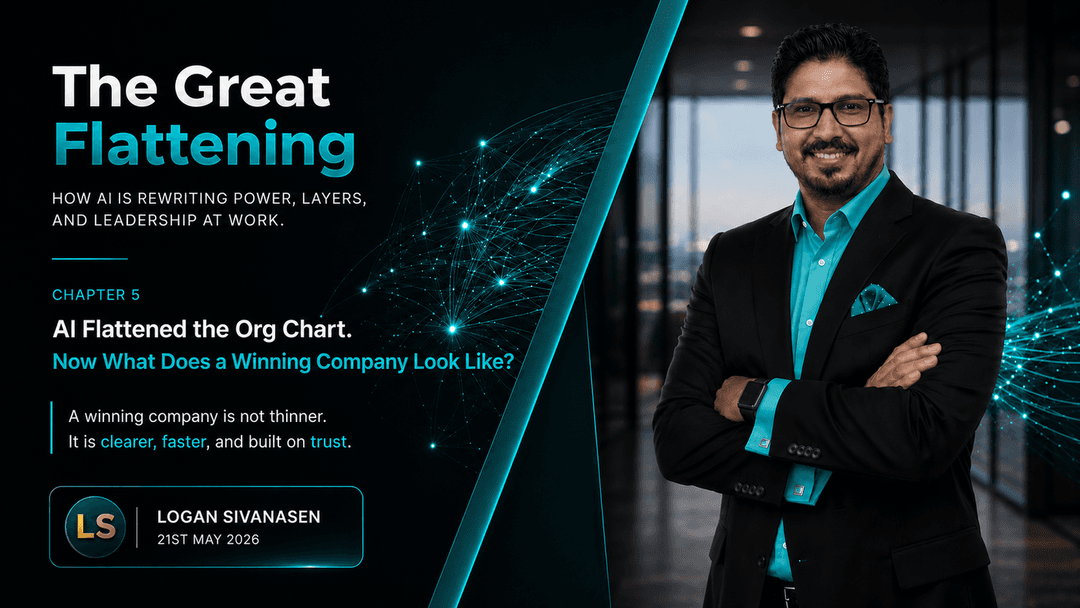
The Great Flattening - Chapter 5: AI Flattened the Org Chart. Now What Does a Winning Company Look Like?
Chapter 5 of The Great Flattening series. A winning company is not thinner. It is clearer, faster, and built on trust.
Chapter 5 of The Great Flattening.
A winning company is not thinner. It is clearer, faster, and built on trust.
The previous chapters of this series documented what AI is doing to organizational structure. It is compressing coordination overhead. It is removing the translation layers between teams. It is pushing decisions closer to the work itself.
But compression is not a strategy. Removing layers is not the same as building something better. And this is where most leadership conversations stall. They focus on what AI takes away and miss the harder question: what does a winning company actually look like after the flattening?
This chapter answers that question directly.
The wrong frame
Most leaders are still asking the wrong question. They are asking: how do we use AI to become more efficient?
The better question is: what kind of company wins when AI handles the coordination, the translation, and the routine synthesis that used to require entire layers of management?
The answer is not a thinner company. It is a different kind of company. One that is architecturally better suited to the environment AI is creating.
What a winning company looks like
Clearer, not just flatter. The winning companies after the flattening are not defined by how few layers they have. They are defined by how clear decision rights are at every level. When AI removes the buffer layers, ambiguity becomes dangerous fast. The organizations that win are the ones where everyone knows what they own, what they can decide, and where to escalate.
Faster at the point of judgment. AI accelerates the production of options, analysis, and recommendations. The constraint becomes judgment - the human decision that turns AI output into committed action. Winning companies redesign their operating models around the speed of judgment, not the speed of production.
Built on trust. Flat structures only work when people trust each other's judgment without requiring layers of approval. Trust is not soft. It is a structural asset. The companies that invest in it - through transparency, clear accountability, and consistent follow-through - will run faster than those still running on hierarchy and sign-off culture.
Designed for agent-assisted work. The winning company in 2026 is not imagining AI as a tool bolted onto the existing org chart. It is designing roles, workflows, and accountability structures around the assumption that AI agents are part of the team. That is a fundamentally different design challenge.
What still has to be human
Flattening does not eliminate the need for human judgment. It concentrates it.
The roles that survive and grow in value after the flattening are the ones that do things AI cannot do at scale: hold context across time, build trust with other people, make judgment calls with incomplete information, and take accountability for outcomes.
These roles do not disappear in a flatter organization. They become more visible, more consequential, and more demanding.
The practical test
A company is winning the flattening if it can answer yes to four questions:
- Can every person in the organization describe what they own and what they decide?
- Are decisions being made faster than they were 12 months ago, with better outcomes?
- Do people trust each other enough to act without waiting for approval?
- Is AI being used to remove friction, or just to produce more of the same output faster?
If the answer to any of these is no, the org chart may have changed but the operating model has not.
What leaders should do now
Redesign decision rights before cutting headcount. The most dangerous version of flattening is removing managers without clarifying what they were actually responsible for. Decision rights have to be explicit before the layers that held them are removed.
Invest in trust infrastructure. This means transparency about direction, consistency between words and actions, and accountability that is real and visible. Trust is not a cultural initiative. It is a structural requirement for flat organizations.
Measure the right things. The goal is not fewer layers. The goal is better decisions, faster flow, and stronger outcomes. Measure those. Not the org chart.
Build for agent-assisted work deliberately. Identify the workflows where AI agents can take on coordination, synthesis, and routing. Redesign those workflows explicitly rather than letting AI adoption happen informally around the edges.
Sources and references
- McKinsey - Reinventing workflows with agentic AI
- Microsoft - Work Trend Index 2025
- Gartner - Top Strategic Technology Trends 2026
- Anthropic - Claude for enterprise teams
LinkedIn post
This article was originally published on LinkedIn.
Read the original here: The Great Flattening - Chapter 5 on LinkedIn
Sources and references
Series: The Great Flattening
Read next
All publicationsThe Great Flattening - Chapter 4: Cut Too Deep and You Break the Company
Chapter 4 of The Great Flattening series. A flatter company is not always a stronger one. The real test is whether the work improves after the cut.
The Great Flattening - Chapter 3: Your Org Chart Is Lying to You. The Real Company Runs Through Flows.
Chapter 3 of The Great Flattening series. Your org chart shows authority. The workflow shows where value moves. AI does not ask which department owns the problem - it finds the friction, the slow handoff, the unclear decision right. The companies that thrive will not have the neatest org charts. They will have the clearest flows.
The Great Flattening - Chapter 2: AI Does Not Remove Work. It Removes Layers.
Chapter 2 of The Great Flattening series. AI is not removing work. It is removing the delay around the work. The approvals, the formatting, the status updates, the meeting summaries, the handoffs - these are not the work. They are the layers around the work. And when the layers go, the work accelerates.