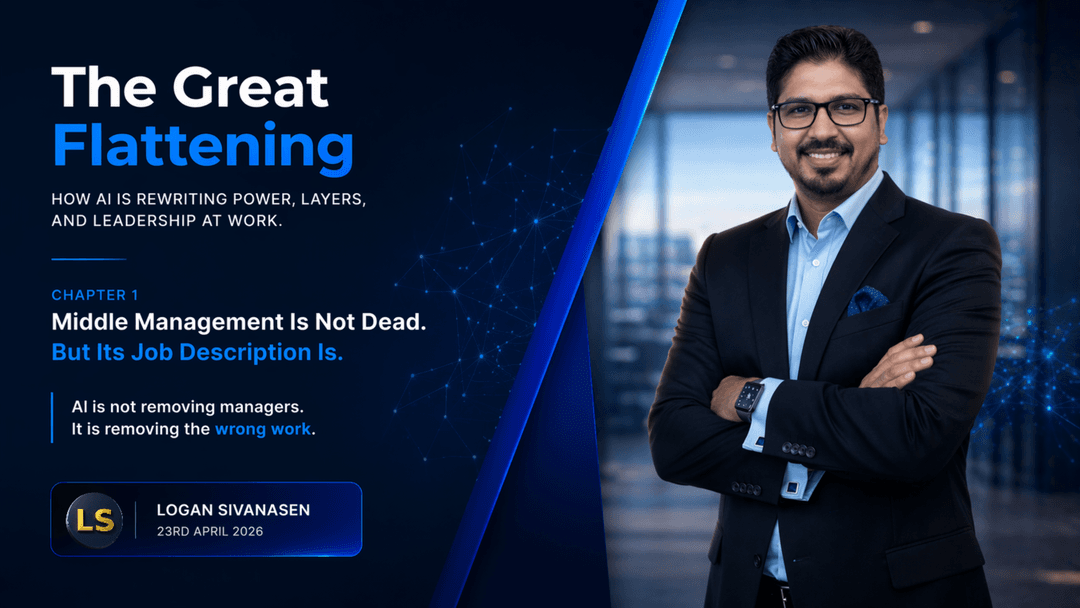
The Great Flattening - Chapter 1: Middle Management Is Not Dead. But Its Job Description Is.
Chapter 1 of The Great Flattening series. AI is not removing managers. It is removing the wrong work. The information gatekeeper, the status updater, the meeting scheduler, the report compiler - those tasks are being automated. What remains is the work that middle management was always supposed to be doing.
Chapter 1 of The Great Flattening.
How AI is rewriting power, layers, and leadership at work.
AI is not removing managers.
It is removing the wrong work.
That is an important distinction. And it changes everything about how organizations should be thinking about middle management right now.
The narrative that AI eliminates middle management is too simple and too convenient. It satisfies people who were frustrated by bureaucracy and frightens people who depend on those roles. Neither reaction is particularly useful.
The more accurate framing: AI is automating the tasks that middle management was forced to do because technology could not do them yet. And the space that opens up is where the real leadership work has always lived.
What Middle Management Actually Does
Before we discuss what AI changes, we need to be honest about what middle management actually does in most organizations today.
Some of it is leadership work. Developing people. Making judgment calls under uncertainty. Translating strategy into context that makes sense for specific teams. Navigating conflict. Holding accountability without destroying motivation. This is hard, important, and irreplaceable.
Some of it is coordination work. Running status updates. Compiling reports. Attending meetings to represent a team that cannot attend themselves. Translating information from one format to another. Routing decisions upward. Filtering priorities downward. This is important - but it is important because the organization is structured in a way that requires it.
And some of it is pure overhead work. Attending meetings that could have been an email. Preparing decks that nobody reads. Writing reports that are skimmed for three bullet points. Sitting in approval chains that exist because trust is low and accountability is unclear.
Microsoft's 2025 Work Trend Index found that employees spend an average of 57% of their time on communication and coordination, and only 43% on actual work output. For managers, this ratio is often worse.
The coordination work and the overhead work are being automated. The leadership work is not.
The Four Tasks Being Automated
When AI enters the management layer, it does not randomly redistribute work. It targets specific categories.
1. Information Aggregation
The manager used to be the person who knew what was happening across the team, the project, and the organization. They attended more meetings, received more reports, and held more context than individual contributors could access.
AI tools now aggregate information across the organization in real time. A team member can query a system and get a summary of where every project stands, what decisions are pending, and what blockers exist - without needing to ask a manager. The information gatekeeper role disappears.
2. Status Reporting
A significant portion of middle management time goes to status reporting. Compiling the weekly report. Preparing the board update. Summarizing the team's progress for the senior leadership review. This work is important to the organization but almost entirely rote once you understand the format.
AI drafts these reports from live data. The manager reviews, adds nuance, and approves. Time drops from hours to minutes. Salesforce's 2026 research found that teams using AI for reporting and documentation reduce administrative time by an average of 3.4 hours per week per manager.
3. Scheduling and Coordination
The calendar management, the meeting logistics, the follow-up emails, the action item tracking - all of this is increasingly handled by AI agents. Not perfectly. But well enough that a manager is no longer the primary coordinator of their team's time and workflow.
4. First-Pass Decision Support
Routine decisions that used to require manager judgment are increasingly handled by AI recommendation engines. Budget approvals under a threshold. Candidate screening against defined criteria. Resource allocation against clear priorities. The manager still makes the final call. But the first-pass analysis that used to consume significant time is automated.
What Remains - And Why It Is Harder
Here is the uncomfortable truth about what AI leaves behind for middle managers: it is the hardest part of the job.
Developing people: AI does not replace the conversation where you help someone understand why they are not yet ready for a promotion. It does not replace the coaching session that shifts how someone thinks about their work. It does not replace the moment where you see something in a person that they cannot yet see in themselves. This is leadership. It requires presence, empathy, and judgment that no model can replicate.
Making judgment calls under ambiguity: When the data is incomplete, the options are unclear, and the consequences are significant, a human still needs to make the call. AI can provide scenarios, probabilities, and precedents. It cannot hold accountability.
Translating strategy into team-specific context: A company-wide strategy that makes sense to a CEO needs to be interpreted through the specific reality of a five-person team working on a niche product in a specific market. That translation requires contextual intelligence and relationship knowledge that AI does not have.
Navigating conflict and building trust: Teams are made of people. People have misaligned incentives, personal histories, different communication styles, and competing priorities. The manager who can navigate this is rare and valuable. AI does not navigate conflict. It avoids it.
The Flattening Effect
As AI absorbs the coordination and reporting layers, organizational structures can get flatter. Not because companies eliminate managers, but because the ratio of managers to contributors can shift when coordination is cheaper.
This is already happening. LinkedIn's 2026 Workforce Insights reports that manager-to-IC ratios are shifting across technology, consulting, and financial services as organizations reduce coordination overhead. The movement is toward fewer, better-empowered managers - not the elimination of the function.
The manager who survives and thrives in this environment is not the one who was most effective at coordination. It is the one who was always best at the parts AI cannot touch: developing people, navigating ambiguity, building trust, and creating the conditions for others to do their best work.
What Leaders Need to Do Now
If you lead managers, or if you are one, three questions matter right now:
1. What percentage of your team's management time is going to work that AI could do? If you do not know, find out. The answer will surprise you.
2. Are your managers developing the skills that will matter more, not less, as AI absorbs the routine? Coaching. Strategic thinking. Conflict navigation. Culture building. These skills have always mattered. They are about to matter much more.
3. Does your organization's structure reflect the coordination costs AI has eliminated, or the coordination costs that existed 10 years ago? Most org charts are fossil records of past assumptions about how hard coordination was. Redesigning around AI-assisted coordination is one of the most valuable things a leadership team can do right now.
The Reframe
Middle management is not dying. The job description of middle management is dying.
The information gatekeeper is automated. The status updater is automated. The meeting scheduler is automated. The report compiler is automated.
What remains is the work that management was always supposed to be doing, but rarely had enough time for.
That is not a crisis for middle management. It is an upgrade - if organizations and managers treat it that way.
Chapter 2 is coming next week: AI Does Not Remove Work. It Removes Layers.
Sources and references
Series: The Great Flattening
Read next
All publicationsThe Great Flattening - Chapter 5: AI Flattened the Org Chart. Now What Does a Winning Company Look Like?
Chapter 5 of The Great Flattening series. A winning company is not thinner. It is clearer, faster, and built on trust.
The Great Flattening - Chapter 4: Cut Too Deep and You Break the Company
Chapter 4 of The Great Flattening series. A flatter company is not always a stronger one. The real test is whether the work improves after the cut.
The Great Flattening - Chapter 3: Your Org Chart Is Lying to You. The Real Company Runs Through Flows.
Chapter 3 of The Great Flattening series. Your org chart shows authority. The workflow shows where value moves. AI does not ask which department owns the problem - it finds the friction, the slow handoff, the unclear decision right. The companies that thrive will not have the neatest org charts. They will have the clearest flows.