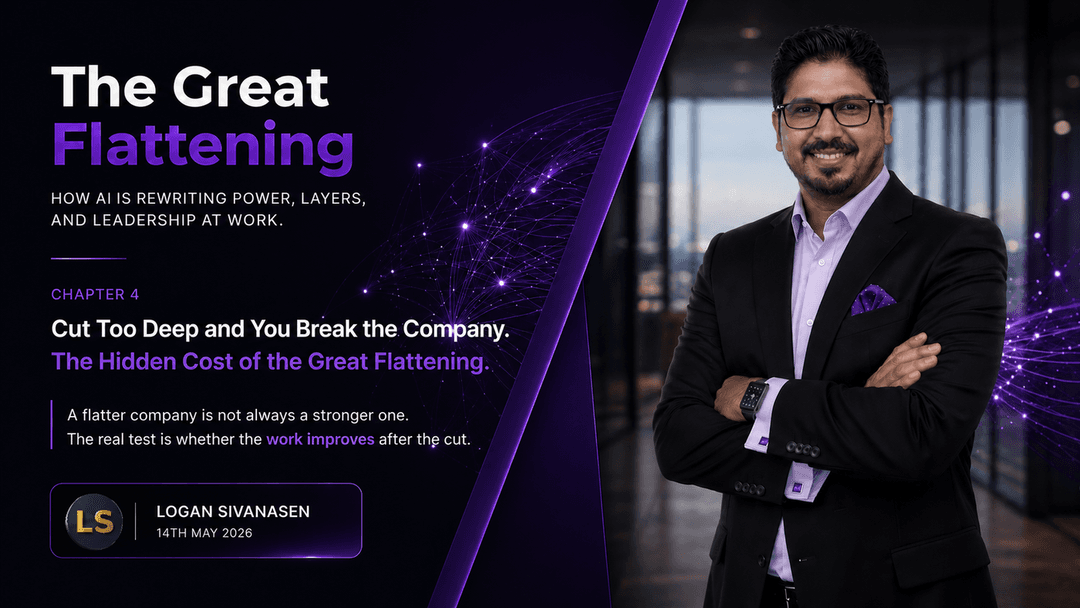
The Great Flattening - Chapter 4: Cut Too Deep and You Break the Company
Chapter 4 of The Great Flattening series. A flatter company is not always a stronger one. The real test is whether the work improves after the cut.
Chapter 4 of The Great Flattening.
A flatter company is not always a stronger one.
The point of this chapter is simple. AI is not only changing the tools people use. It is changing where work sits, who carries context, and which layers of the organization still add value.
That sounds efficient. But efficiency is not the same thing as effectiveness. And when leaders cut layers without redesigning the work beneath them, they can damage speed, context, and accountability at the same time.
In practice, this means organizations need to look at the work itself, not just the org chart around it.
The real question is not whether AI can produce more output. It is whether the layers around the work are helping or slowing it down. If the answer is wrong, a flatter company can become a thinner company very quickly.
What the chapter argues
- AI compresses coordination overhead
- AI reduces translation between teams and formats
- AI shifts value toward judgment, context, and ownership
- Leaders need to redesign workflows before redesigning structures
- Cutting too deep can remove the people who hold context and keep the system coherent
- The goal is not fewer layers at any cost, but better layers with clearer purpose
- Real organizational improvement comes from removing friction, not just removing people
Why it matters
Most companies still treat AI as a productivity layer. The more useful view is that AI changes the operating model. It exposes where work is trapped in handoffs, approvals, and status reporting.
If those layers are left untouched, the business gets more output without better flow. If they are redesigned, the organization gets faster and clearer. If they are cut without redesign, the business can lose the very judgment and coordination that made it work.
What gets broken when companies cut too deep
Context gets hollowed out: The people who know why a decision exists are often not the people who appear in the final org chart. Remove them too aggressively and the company keeps moving, but it no longer knows what it is moving toward.
Decision quality drops: A flatter structure is only good when decision rights are clear. If you remove layers but do not replace them with explicit ownership, decisions become faster and worse at the same time.
Coordination becomes invisible: Work still needs synthesis, escalation, translation, and follow-up. If nobody owns those jobs, they do not disappear. They just become everyone’s problem and therefore no one’s responsibility.
Morale can crack: People do not just react to the number of layers. They react to whether the cuts feel thoughtful or arbitrary. A company that cuts for optics will create fear, not momentum.
What leaders should do instead
Redesign before you remove: Map the work, the decisions, the dependencies, and the people who hold context. Then decide what can be automated, what can be merged, and what must stay human.
Protect the roles that hold the system together: Not every role should survive, but some roles exist because they preserve clarity, quality, and trust. Those jobs should be strengthened, not casually eliminated.
Measure the result after the cut: A flatter org chart is not success by itself. Success is faster decisions, better flow, clearer ownership, and stronger outcomes.
Use AI to remove waste, not wisdom: The best use of AI in org design is to remove repetitive coordination, not to erase the people who understand the business deeply.
Sources and references
- McKinsey - Reinventing workflows with agentic AI
- Microsoft - Work Trend Index 2025
- Gallup - State of the Global Workplace
- Microsoft - Copilot for work
LinkedIn post
This article was originally published on LinkedIn.
Read the original here: The Great Flattening on LinkedIn
Sources and references
Series: The Great Flattening
Read next
All publicationsThe Great Flattening - Chapter 5: AI Flattened the Org Chart. Now What Does a Winning Company Look Like?
Chapter 5 of The Great Flattening series. A winning company is not thinner. It is clearer, faster, and built on trust.
The Great Flattening - Chapter 3: Your Org Chart Is Lying to You. The Real Company Runs Through Flows.
Chapter 3 of The Great Flattening series. Your org chart shows authority. The workflow shows where value moves. AI does not ask which department owns the problem - it finds the friction, the slow handoff, the unclear decision right. The companies that thrive will not have the neatest org charts. They will have the clearest flows.
The Great Flattening - Chapter 2: AI Does Not Remove Work. It Removes Layers.
Chapter 2 of The Great Flattening series. AI is not removing work. It is removing the delay around the work. The approvals, the formatting, the status updates, the meeting summaries, the handoffs - these are not the work. They are the layers around the work. And when the layers go, the work accelerates.