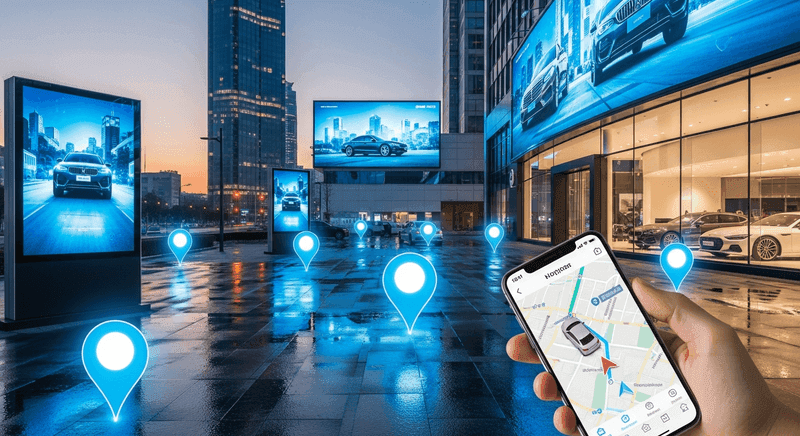
Geomarketing Takes The Driver's Seat
How OOH + Mobile Will Drive Traffic To Car Showrooms. The automotive industry is ripe for a geomarketing revolution that combines out-of-home advertising with mobile targeting.
How OOH + Mobile Will Drive Traffic To Car Showrooms
The automotive industry has always been about the journey - both literally and figuratively. From the first test drive to the final signature, the car buying journey is one of the longest and most considered purchase decisions consumers make. And yet, automotive marketers have traditionally relied on broad-stroke advertising approaches that fail to capture the nuances of this complex journey.
Enter geomarketing: the convergence of location intelligence, out-of-home advertising, and mobile targeting that promises to transform how car brands connect with potential buyers.
The Auto Buyer's Journey Has Changed
Today's car buyer doesn't walk into a showroom cold. They've already:
- Researched models and specifications online
- Compared prices across multiple sources
- Read reviews and watched video content
- Narrowed down their consideration set
By the time they visit a showroom, they're typically 60-70% through their decision-making process. This means the opportunity to influence begins long before the showroom visit - and geomarketing provides the tools to do exactly that.
The Power of OOH + Mobile Integration
Out-of-home advertising has always been effective for automotive brands - think of those stunning billboards featuring the latest SUV conquering a mountain road. But traditional OOH has a measurement problem: how do you know if that billboard actually drove showroom visits?
The answer lies in integrating OOH with mobile targeting:
Sequential Targeting
When a consumer passes a billboard for a new sedan, their mobile device can be identified (anonymously and with consent). That consumer can then receive follow-up mobile ads that reinforce the billboard message, provide additional information, or invite them to book a test drive.
Showroom Attribution
By tracking device movements (with appropriate privacy protections), marketers can measure which OOH placements actually drove showroom visits. This closes the attribution loop that has long plagued outdoor advertising.
Competitive Conquesting
Know when consumers are visiting competitor showrooms? Mobile targeting allows you to reach them with compelling offers that highlight your advantages.
Key Geomarketing Strategies for Auto Brands
1. Commuter Corridor Targeting
Car buyers spend significant time in traffic - often contemplating their next vehicle purchase. Target OOH placements along high-traffic commuter routes and follow up with mobile ads during and after the commute.
2. Life-Stage Triggers
Location data reveals life-stage changes that often trigger car purchases: visits to new neighborhoods (house hunting), baby stores (family expansion), or college campuses (graduation). Target consumers showing these behavioral signals.
3. Service Center Targeting
Consumers at service centers for aging vehicles are prime prospects for new purchases. Reach them with trade-in offers and new model information while they're already thinking about their car.
4. Weekend Activity Correlation
Understanding weekend behaviors helps with vehicle matching. Consumers frequenting outdoor recreation areas might be perfect for SUVs; those visiting golf courses might appreciate luxury sedans.
Measuring Success
The beauty of geomarketing lies in its measurability. Unlike traditional advertising where success metrics are often proxies (impressions, recall), geomarketing enables direct measurement of:
- Showroom visits: Did exposure to advertising drive physical visits?
- Dwell time: How long did visitors spend at the showroom?
- Competitive comparison: How do your showroom visits compare to competitors?
- Conversion correlation: What advertising mix correlates with actual purchases?
The Road Ahead
Geomarketing is taking the driver's seat in automotive advertising. By combining the visual impact of OOH with the precision of mobile targeting and the accountability of location-based measurement, car brands can finally optimize their marketing spend with confidence.
The days of hoping that billboard investment pays off are over. With geomarketing, automotive marketers can know - with data-backed certainty - which campaigns drive traffic to showrooms and ultimately, keys into customers' hands.
Sources and references
Series: Publications
Read next
All publicationsA Christmas Wishlist from Marketing Heaven.
For once, smart marketers have someone to fulfill their Christmas wishes too, after years of revenues targets and ROI questions looming large after every shopping season. It's Christmas for everyone because LifeSight's got your back!
Sports Retailers - Are You Still Shooting Arrows In The Dark?
Sports retailers need a quick and amazing new marketing strategy, which is as data driven as their other retail counterparts. Geomarketing is one way to achieve it, because nothing is more of a give away of a customer's hobbies and lifestyles as the places he goes when he is not at work!
Real Estate Marketing - Data To The Rescue
Data allows real estate companies and middlemen such as dealers and brokers make engaging comparisons - between locations, between features, between neighborhood and safety best practices, as well as the right audience for each property.