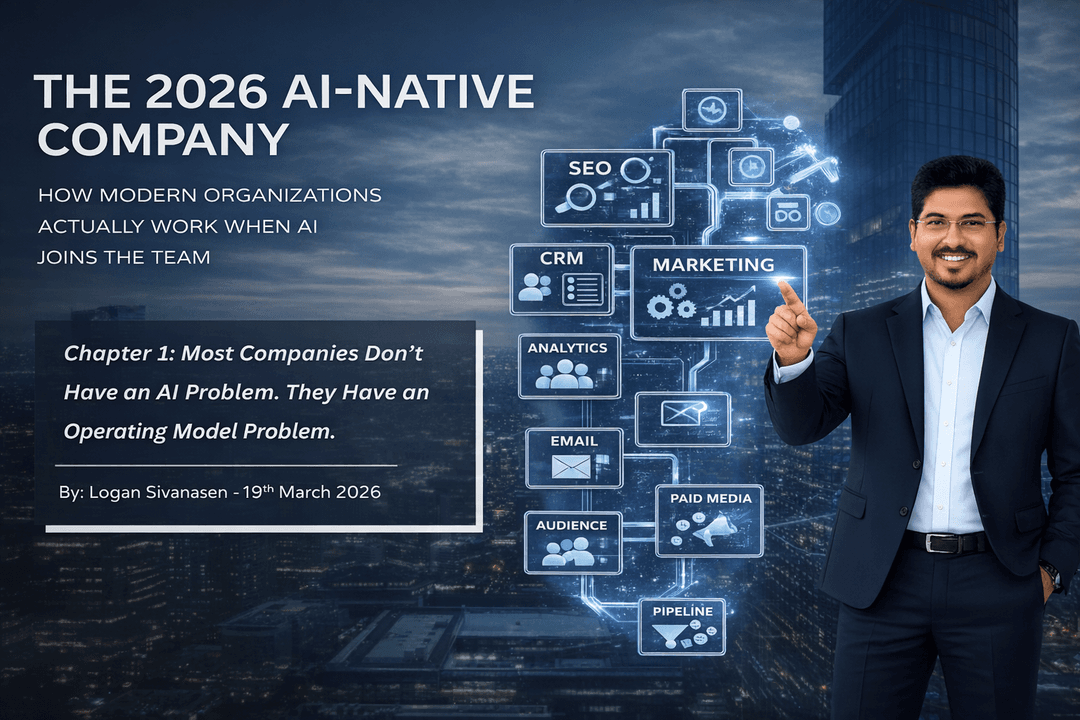
The 2026 AI-Native Company - Chapter 1: Most Companies Don't Have an AI Problem. They Have an Operating Model Problem.
Chapter 1 of a new series. Most companies in 2026 don't have an AI strategy. They have a list of AI purchases. Tools stacked on tools, pilots running in parallel, budgets scattered across departments - and no one can explain how it all connects to revenue, margin, or competitive advantage.
Chapter 1.
Most companies in 2026 don't have an AI strategy. They have an AI shopping list.
Tools stacked on tools. Pilots running in parallel. Budgets scattered across departments. And no one - not the CTO, not the CMO, not the CEO - can explain how it all connects to revenue, margin, or competitive advantage.
This is not a technology problem. It is a strategy problem wearing a technology costume.
The Pattern
I keep seeing the same pattern across companies in APAC, Europe, and the US. The conversation starts the same way:
"We're using AI."
OK. Where?
"Marketing has Jasper. Sales has Gong. Product has Copilot. Finance has some forecasting tool. HR is piloting something for screening."
Great. What's the strategy that connects all of that?
Silence.
That silence is the gap. And it is expensive. Not because the tools are bad, but because without a strategy, you get:
- Duplicate capabilities across departments (three teams paying for summarization)
- No shared data layer (each tool sees a slice, nobody sees the whole picture)
- Conflicting automation logic (Sales AI says qualify, Marketing AI says nurture)
- No way to measure aggregate impact (each team reports "productivity gains" in isolation)
- Vendor lock-in happening quietly across the org
This is how companies end up spending more on AI and getting less from it.
Why This Happens
Three forces push companies toward shopping lists instead of strategies:
1. Speed Pressure
The board wants to see AI initiatives. Investors ask about AI in every call. Competitors announce AI features weekly. The pressure to "do something with AI" is real and relentless.
So teams buy. They buy fast. They buy what's available. And they call it progress.
2. Decentralized Adoption
AI tools are cheap enough and easy enough that individual teams adopt them without central coordination. A marketing manager signs up for an AI writing tool. A sales lead starts using an AI note-taker. A product manager experiments with code generation.
None of this is wrong. All of it is uncoordinated.
3. The Strategy Void
Most companies still don't have a clear answer to the fundamental question: "What does AI-native mean for us?"
Not "what AI tools do we use?" but "how does AI change our operating model, our cost structure, our competitive positioning, and our talent strategy?"
Without that answer, every AI purchase is a guess.
What an AI Strategy Actually Looks Like
An AI strategy is not a list of tools. It is a set of decisions about:
Where AI creates leverage - Which processes, decisions, or capabilities get fundamentally better with AI? Not incrementally. Fundamentally.
Where AI creates risk - Which AI applications expose you to regulatory, reputational, or operational risk? Where do you need guardrails?
What you stop doing - An AI strategy should kill things. If AI handles summarization, you stop hiring for summarization. If AI handles first-pass analysis, you restructure the analyst role. Strategy without subtraction is just addition.
How you measure impact - Not tool-level metrics ("we generated 500 drafts"). Business-level metrics ("cost per qualified lead dropped 30%", "time to first response dropped from 4 hours to 20 minutes").
How you govern - Who approves new AI tools? Who owns the data layer? Who decides when an AI output needs human review?
The Shopping List Test
Here is a quick diagnostic. Count the number of AI tools your company pays for. Now answer these questions:
- Can you explain how each tool connects to a business outcome (revenue, cost, speed, quality)?
- Do any two tools share data or build on each other's outputs?
- Is there one person who knows the full list?
- Have you retired any tool after finding it didn't deliver?
- Could you draw the AI architecture on a whiteboard in under 5 minutes?
If you answered "no" to three or more, you have a shopping list. Not a strategy.
What AI-Native Actually Means
AI-native does not mean "uses a lot of AI." It means the organization's operating model assumes AI as a core capability, not an add-on.
An AI-native company:
- Designs workflows around AI-augmented decisions, not human-only processes with AI bolted on
- Treats data as shared infrastructure, not departmental property
- Builds feedback loops where AI outputs improve over time based on human corrections
- Has clear governance for when AI decides, when AI recommends, and when humans decide
- Measures AI impact at the business level, not the tool level
This is the journey from shopping list to strategy. And it starts with one honest conversation: "What are we actually trying to become?"
Coming Next
Chapter 2 will explore the talent side of this equation. Because your next best hire might not be a person.
Sources and references
Series: The 2026 AI-Native Company
Read next
All publicationsThe 2026 AI-Native Company - Chapter 5: The AI-Native Org Chart. Fewer Handoffs, Fewer Tools, More Growth.
Chapter 5 of The 2026 AI-Native Company series. The org chart is the most underrated strategy document in any company. It determines how decisions flow, how information travels, how fast ideas become execution. The AI-native org chart looks different - and it produces different results.
The 2026 AI-Native Company - Chapter 4: The AI-Native Company Runs in Real Time. Most Teams Still Work in Delays.
Chapter 4 of The 2026 AI-Native Company series. There is a specific kind of competitive disadvantage building right now in most organizations. It is not visible in the org chart or the strategy deck. It lives in the gap between when something happens and when the business responds to it.
The 2026 AI-Native Company - Chapter 3: The AI-Native Company Does Not Run Campaigns. It Runs Conversations.
Chapter 3 of The 2026 AI-Native Company series. Every campaign is a batch. A batch of content, a batch of timing, a batch of assumptions about what the audience wants right now. The AI-native company has moved past campaigns. It runs always-on conversations driven by real-time signals.